
Forklift Guidance System
No Barcode Scans Tracking with RTLS 100% Paperless 3D Visualization Flexibly Configurable
Fewer detours. Higher throughput. Manage all your forklifts centrally and 100% digitally. No empty runs, no chaos.
With the Forklift Guidance System (FGS) from OneBase®MFT, all material handling in the warehouse is carried out transparently and priority-driven. For lower operating costs and optimized warehouse utilization.

Our SLS in
90 seconds.
What makes the Forklift Guidance System from OneBase®MFT so special?
Are you also wasting time and money every day?
Efficiency
Barcode scans & manual booking
Uncoordinated movements
Lost Time
approx. 20 seconds per operation
15–25% empty runs daily
Money
Delays, high error rate
Energy, wear and tear, working hours
A Forklift Guidance System ensures:
Search and Scan Times
Targeted Transports
Time Savings per Employee per Day
Are you already familiar with our
OneBase®MFT Configurator?
Configure your ideal OneBase®MFT now and immediately receive the complete report including cost estimate via email.

Never search for material again. Efficiency for your forklift fleet.
The ABF Forklift Guidance System is intelligent and noticeably relieves your team.
Long-term and measurable results:
Search and Scan Times
Targeted Transports
Time Savings per Employee per Day
Your forklift fleet always under control.
Hardware and Software Combined.
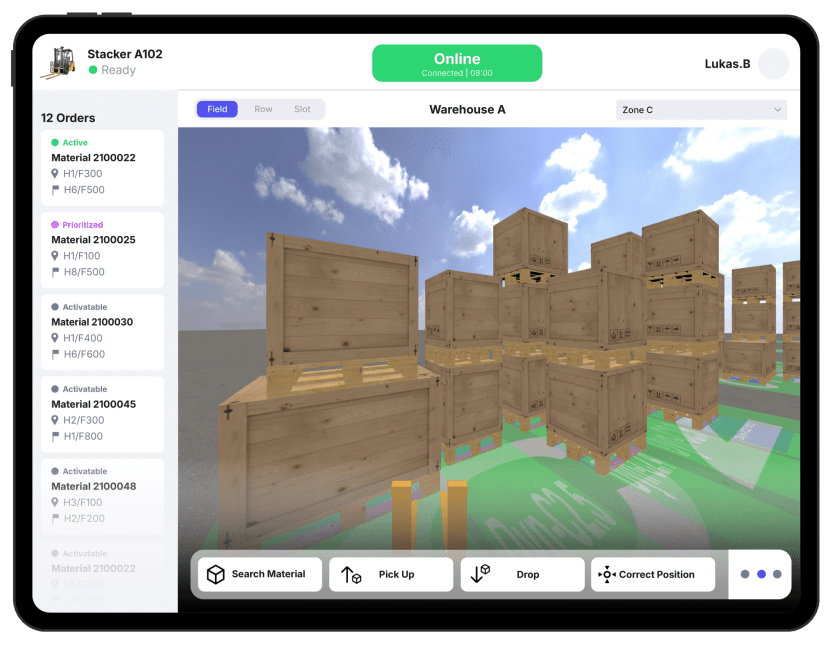
Real-time localization with RTLS, automatic transport order creation, and seamless material tracking without barcode scans. The highlight for operators: All transport orders are displayed in real-time on the in-vehicle terminal.
Optimized Travel Orders and Easy Navigation
3D Forklift Guidance System
The system controls all movements through path- and time-optimized orders. The intuitive 3D warehouse view assists with quick navigation to the next order destination.
Forklift Localization
Real-Time Locating System (RTLS)
The forklift’s position is continuously determined within the coordinate system and used by the Forklift Guidance System for automatic detection of material movements. Depending on the environmental conditions in the warehouse, as integration specialists, we deploy various RTLS systems.
D-GPS (outdoor)
Radar (indoor)
Automatic material tracking
Smart Sensors
Through additional sensor technology, material movements are detected in the Forklift Guidance System without manual bookings or barcode scans. This prevents errors and saves costs.
Ultrasonic, oil pressure sensor
Sensor Fusion and Pre-processing
ABF Edge Node
RTLS and sensor technology are integrated, and load change signals, including the vehicle’s position, are transmitted to the Forklift Guidance System in real-time for recording material movements.
Optimal Maintenance
Interactive User Guidance
Our innovative Forklift Guidance System impresses with an interactive 3D warehouse view, enabling intuitive orientation within the warehouse – even for new employees. Operation is either via touch gestures or fully automated: the 3D view adapts in real-time, controlled by connected sensor technology, and represents the digital twin of the real warehouse.
As a central interface between operator and vehicle technology, the system integrates, among other things, a localization system, lift height sensor technology, and load detection. Material movements are thus automatically detected, verified, and seamlessly tracked. Relevant feedback and navigation instructions are visualized for the driver in real-time on the vehicle terminal – for maximum transparency and process reliability in warehouse operations.

Intelligent Fleet Optimization through Travel Orders
The Forklift Guidance System dynamically optimizes all upcoming transport requirements, ensuring efficient deployment of the entire fleet. The rule engine considers various factors to avoid empty runs and unnecessary waiting times:
- Route Optimization: Selection of the shortest or fastest route based on real-time data
- Multi-stage Transports: Automatic chaining of partial routes into a complete order
- Double Cycles: Intelligent combination of outbound and return trips to avoid empty movements
- Forecasts: Optimized destination finding considering the next process steps
- Reduction of Relocations: Planned retrievals are incorporated into the putaway strategies
- Target Times: Optimized timing at transfer points and bottlenecks
These functions lead to shorter transport times, higher productivity, and a significant relief of forklift resources.
Mixed Fleet Operation
The OneBase®MFT guidance system not only supports all types of manual forklifts but is also the ideal intralogistics solution for the higher-level control of various types of transport equipment (e.g., AGVs, manual and automatic cranes, shuttles, tractors, tugger trains, etc.).
- Central Overarching Control of all vehicle types (automated & manual)
- Intelligent Transport Assignment (shortest paths, priority, load distribution to avoid bottlenecks, etc.)
- Assignment of Transport Orders depending on vehicle availability, position, charge status, payload, etc.
- Dynamic Route Planning
- Multi-Vendor Compatibility
Safety Cockpit
The OneBase®MFT Forklift Guidance System contributes to increased safety in your warehouse. To this end, it provides functions for collision and speeding warnings. By integrating RTLS, the current speed, direction, and position of the forklift can be used to calculate potential collisions.
Speed zones can be defined in the MFT system. In these defined zones, the current forklift speed is compared with a defined speed limit. If the forklift exceeds the limit, the driver is visually warned via the Forklift Guidance System.

Navigation System
The Forklift Guidance System is equipped with a powerful 3D navigation system that reliably guides the driver to the next source or destination of their current order. Navigation occurs in real-time and considers all driving rules stored in the system. Via the user-friendly configurator application, driving paths can be individually adjusted – including permissible speeds, path widths, and the definition of unidirectional or bidirectional routes. This ensures optimal route guidance, considering safety and efficiency requirements.

Your warehouse also has enormous savings potential. We will show you where.
Your investment pays off – and faster than you think: Amortization in under 2 years.
Request your individual potential analysis today. Our experts will provide you with:
- a thorough assessment of your current processes
- specific savings potential in time & costs
- comprehensive ROI calculation for your warehouse
Case Studies
The OneBase®MFT Forklift Guidance System ensures efficient processing of transport orders while maintaining the lowest possible operating costs.
Robert Bosch Sistemas Automotrices S.A. de C.v.
3D forklift guidance system in high-bay warehouse with SAP WM connection
Find answers to frequently asked questions
What is a Forklift Guidance System (FGS)?
A Forklift Guidance System (FGS) is software for managing and controlling industrial trucks (forklifts/stackers). Transport orders are created centrally and assigned to the various transport vehicles paperlessly and prioritized. At the same time, the status and position of each transport vehicle can be transparently tracked – thus avoiding material bottlenecks or empty runs.
The FGS from OneBase®MFT also offers scan-free warehouse management using RTLS – material movements are automatically posted. And thanks to 3D warehouse visualization, you maintain an overview at all times.
How is the Forklift Guidance System integrated into existing IT?
What does Digital Twin / 3D Warehouse Visualization mean?
The Digital Twin is the digital representation of your warehouse. Inventory, storage locations, and material and vehicle positions are continuously recorded and displayed in an interactive 3D visualization.
This allows you to oversee even complex or particularly large warehouses – conveniently from your desk at any time.